Bathroom Cabinets: Types, Sizes and How to Choose the Right One
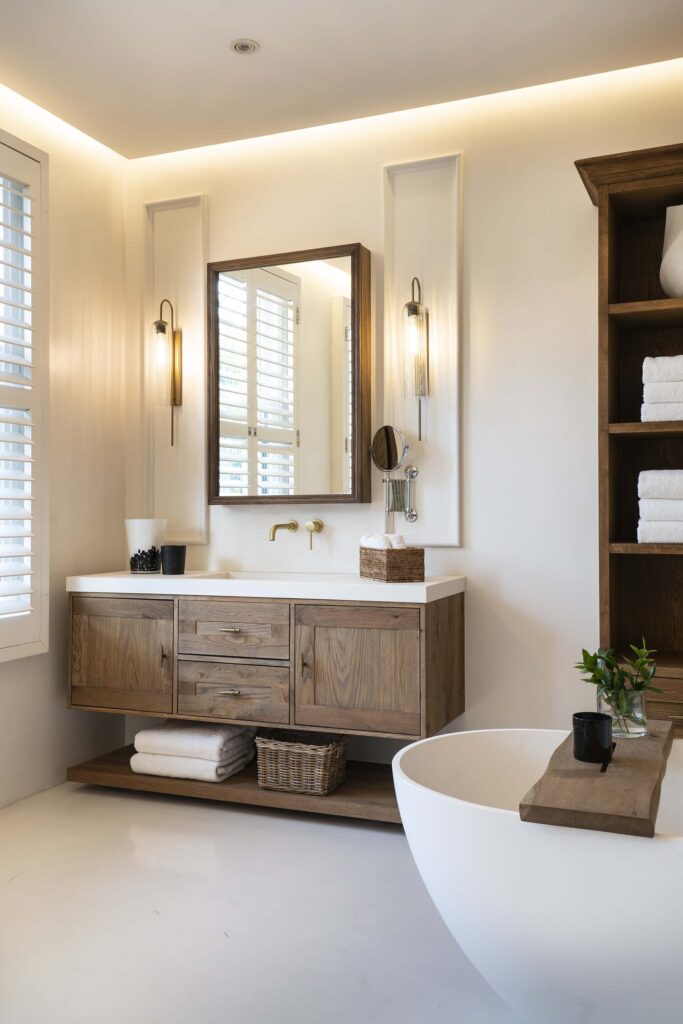
Bathroom cabinets do the quiet work in a bathroom. They carry the basin, hide the plumbing, and swallow the clutter that would otherwise live on every flat surface, all in a room that is hot, humid and wet several times a day. Choosing well means looking past the door front, because the difference between a cabinet that still looks good in ten years and one that swells along its bottom edge in two comes down to the carcass material, the hinges and the way it is fixed to the wall.
What counts as a bathroom cabinet
The term covers a wider family than most people expect. A vanity cabinet sits under the basin. A mirror cabinet hangs above it. Tall cabinets stand floor to ceiling for towels and linen, side cabinets fill the awkward gap beside a vanity, and low cabinets tuck under a window or beside the bath. Wall shelves and ledges sit at the open end of the same spectrum.
They share one requirement: everything has to cope with steam. A kitchen cupboard front and a bathroom cabinet front can look identical and behave very differently after a few hundred hot showers.
The main types of bathroom cabinet
Vanity cabinets
The vanity cabinet is the workhorse. It supports the basin, conceals the trap and the isolating valves, and provides the bulk of the storage in most bathrooms. Our bathroom vanity cabinets range covers cabinet-only options for people replacing a carcass under an existing basin, alongside units designed around a specific basin shape.
Wall-mounted (or floating) cabinets leave the floor clear, which makes a small bathroom read as larger and makes cleaning underneath trivial. They do need a sound wall and proper fixings, since the cabinet, the basin, the water and the contents all hang off the brackets. Floor-standing cabinets are more forgiving of uneven walls and give you more internal volume for the same footprint.
If you would rather buy the cabinet, basin and top as a matched set, the bathroom vanity sets and the broader bathroom vanity units ranges do that work for you. We have covered the vanity decision in far more depth in our complete bathroom vanity guide.
Mirror cabinets
A mirror cabinet earns its keep by giving you storage in the one place a bathroom usually has none, the wall above the basin. Recessed versions sit inside the wall cavity and finish flush, which looks cleaner but needs to be planned before tiling. Surface-mounted versions simply screw to the finished wall and can be fitted at any point.
The trade-off is depth. A mirror cabinet projects further from the wall than a plain mirror, so in a narrow bathroom where someone has to squeeze past the basin, a flat mirror plus a separate cabinet elsewhere is often the better answer. Our bathroom mirrors and LED bathroom mirrors ranges cover that route, and our bathroom mirrors guide goes through sizing and lighting in detail.
Tall, side and low cabinets
These are the pieces that turn a functional bathroom into an organised one. Tall cabinets take towels, spare linen and bulk toiletries off the vanity entirely. Side cabinets are designed to sit alongside a vanity at the same height and finish, extending the run without looking bolted on. Low cabinets work under a window or beside a bath where a full-height unit would block light.
Geberit builds this out properly across its Smyle Square, Xeno², iCon, Acanto and Selnova Square ranges, so you can specify a low cabinet, a medium cabinet and a side cabinet in the same finish as the vanity. Duravit does the same through the No.1 range. You can browse both at Geberit and Duravit.
Open shelving and wall storage
Not everything needs a door. Open low cabinets, wall shelves and shallow ledges suit the items you reach for daily and the ones you actually want on display. Our glass shelf range handles the classic version, and the bathroom storage units range covers wall-mounted baskets, ledges and rail systems for the small things that never find a home.
Getting the sizes right
Cabinet sizing is where most bathroom projects come unstuck, usually because the unit was chosen before the room was measured properly.
Compact cabinets for a cloakroom or hand basin start around 360 to 400mm wide. Mid-size vanity cabinets typically land between 600 and 900mm, which suits the majority of family bathrooms. Larger runs go to 1200mm and beyond, and a double vanity generally needs at least 1200mm to give two people usable space, with 1500mm being far more comfortable.
Depth matters just as much and gets ignored more often. Cabinets in our range run from roughly 280mm deep for slimline and hand-basin units up to about 500mm for a full vanity. In a bathroom where the door swings inward or a shower sits opposite, dropping from 500mm to 400mm can be the difference between a room that works and one that feels cramped. Measure the clear floor space you will be left with, not just the wall you are filling.
For wall-mounted cabinets, fix the height early. Most people find a finished basin rim between 800 and 870mm above floor level comfortable, and the cabinet height follows from that. Decide before the tiler starts, because moving a wall fixing afterwards means drilling through finished tiles.
Materials and finishes that survive a bathroom
Carcass material is the single biggest predictor of how a bathroom cabinet ages. Standard MDF is popular for cabinetry because it machines cleanly and takes a flawless painted finish, but it is an indoor material with poor moisture resistance, and untreated board will swell if it stays wet. That is exactly why moisture-resistant board grades exist, and why quality bathroom cabinets use them. Clear Cube's Trento and Venice cabinets, for example, are built on moisture-proof MFC rather than standard board.
Most cabinet faces you will see are melamine-faced. Melamine resin is used to saturate a decorative paper, which is then laminated under heat and pressure onto the board. It gives you a hard, easily cleaned surface and, in the wood-textured versions, a convincing timber look without timber's appetite for moisture. Geberit uses this approach across its hickory and oak wood-textured finishes.
On colour, the range in stock tells its own story. High-gloss white and matt white remain the safe, light-reflecting default. Beyond that, matt lava, sand grey, scultura grey and the wood-textured hickory, oak and white oak finishes are where most current specifications land. Matt finishes hide water spotting better than gloss; gloss bounces more light around a dark bathroom. Neither is wrong, but pick one and commit, because a bathroom with three different sheens rarely looks deliberate.
Hardware and internal fittings
Hinges and runners are the parts you touch every day and the parts that fail first if they are cheap. Soft-close is now standard across the better ranges and is worth insisting on.
Internal fittings are the difference between storage and a cupboard full of fallen bottles. Look for pull-out compartments, internal drawers nested inside a deeper drawer, and drawer inserts or T-partitions that divide the space into something usable. Geberit's Xeno² drawer inserts and Acanto's magnetic board with storage boxes are good examples of manufacturers taking the inside of the cabinet as seriously as the outside.
Matching cabinets to the rest of the bathroom
A cabinet is rarely bought in isolation. Two things need checking before you order.
First, the basin. Cabinets are frequently designed around a specific basin type, whether that is a slim-rim vanity basin, a lay-on basin sitting on a washtop, or a compact hand-rinse basin. Confirm the pairing rather than assuming, and browse the bathroom basins range alongside the cabinet you are considering.
Second, the metalwork. Handles, rails, hooks and holders should agree with your tapware. Matt black, brushed brass, gunmetal and chrome all live happily in our bathroom accessories range, but mixing two of them across one small room needs a confident hand.
What bathroom cabinets cost
The spread is wide. Across our vanity cabinet range, prices currently run from a little over R770 for wall shelves and drawer organisers up to beyond R70,000 for a large designer cabinet configuration with matching washtops. Most single-basin cabinets for a family bathroom sit comfortably between those extremes.
The honest advice is to spend on the carcass and the hardware rather than the door colour. A moisture-resistant carcass with soft-close runners in a plain white finish will outlast a fashionable front on a cheap board every time, and finishes are far easier to live with than a swollen cabinet base.
Come and open a few doors
Cabinets are difficult to judge from photographs. The weight of a drawer, the quality of a soft-close, the way a matt finish handles fingerprints, all of it makes more sense in person. Visit our Kramerville showroom to compare finishes side by side and talk sizes through with someone who has specified a few hundred bathrooms, or start browsing the full bathroom vanity cabinets and Clear Cube ranges online. The coffee is genuinely good.