Shower Traps and Shower Channels: Sizes, Types and How to Choose
A shower trap is the least glamorous thing you will specify for a bathroom and the one most likely to spoil it. Get it wrong and you live with standing water on the shower floor, a faint drain smell that never quite clears, or a beautifully tiled shower that has to come up again six months after it went down. This guide covers what a shower trap does, how point traps differ from linear shower channels, the sizes and outlet diameters to pin down before the screed goes in, and how to match the cover to the rest of the room.
What a Shower Trap Actually Does
It has two jobs. The first is obvious: carry waste water from the shower floor into the drainage pipework. The second is the one that matters, and it is done by a water seal — a small volume of water held permanently below the grate, sitting between your bathroom and the foul drain. Sewer gas cannot cross standing water, so as long as that seal stays intact the shower is odourless. It is the same principle used under every basin in the house, and worth understanding how a plumbing trap works before you choose one.
Water Seal Depth
Trap bodies are specified by seal depth, and the number is not cosmetic. Geberit shower drains in our range are offered with 30mm, 40mm and 50mm water seals. A deeper seal holds more water, so it is far harder to siphon or evaporate dry — which matters in a guest bathroom or a holiday house that stands unused for weeks. The shallower 30mm option exists because it needs less depth below the finished floor, often the deciding factor over a concrete slab. Geberit also supplies a split cover that lets the same 90mm body run at either a 30mm or 50mm seal, so the choice can be made on site.
Point Traps Versus Linear Shower Channels
Almost every shower drainage decision comes down to this one. Both work. They simply ask different things of the floor.
Point Traps
The familiar square or rectangular grate set into the middle or the corner of the shower floor. Point traps are the least expensive route, they only require a fall across one small area, and they suit moulded trays as easily as tiled floors. Common formats in our shower channels and traps range include square traps, 150 x 100mm rectangular traps, and Hansgrohe's RainDrain Point and Spot sets in 100 x 100mm and 150 x 150mm with tileable rear covers.
One distinction worth making: if you are draining a moulded tray rather than a tiled floor, you want a tray waste, not a floor trap — typically a 90mm waste that drops into the pre-formed hole. Choose it alongside whichever unit you take from our shower trays collection. The same logic applies to baths, so see our bath wastes range and our guide to choosing a bath tub if you are doing the whole room at once.
Linear Shower Channels
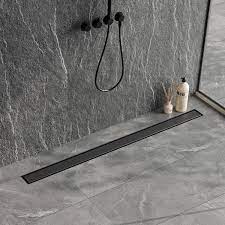
A channel drain runs along one edge of the shower, usually the wall furthest from the entry, and takes water off a floor that falls in a single direction. That single fall is exactly why designers reach for them. A floor sloping one way is far easier to lay in large-format tiles than one dished towards a central point, where every tile has to be cut and warped into the fall. It is also the standard approach in a level-access wet room, where there is no upstand or tray to contain the water.
Lengths in our range start at a 120mm compact channel and run to 1,300mm. Gio Plumbing covers 250mm, 500mm and 860mm; Expanda Drain runs 300mm, 485mm, 600mm, 685mm, 785mm, 885mm and 1,185mm; the Hansgrohe RainDrain Allround and Compact sets cover 600mm to 1,200mm; and Geberit CleanLine channels are cuttable on site to any length between 300mm and 1,300mm. Cuttable is worth the premium on a bespoke shower — you order one part number and trim it to the opening, instead of compromising the layout to suit a fixed length. Hansgrohe's RainDrain Flex works the same way and is designed for wall mounting.
Wall Drains
The third option hides the drainage in the wall junction, behind a tiled or brushed stainless cover. Geberit supplies collector profiles in 1,140mm and 1,500mm lengths. It is the most expensive route and the most demanding to build, but nothing shows on the floor at all.
Getting the Sizing Right
Outlet Diameter
The outlet is where the trap meets your waste pipe, and it must be settled before the plumbing is roughed in. Our range covers 40mm on the simplest PVC traps, 50mm on most stainless steel drain bodies and channels, 90mm on the larger Geberit floor drains and tray wastes, and 110mm on industrial and patio drains. A larger outlet clears water faster, which matters more than people expect once a generous overhead unit from our shower heads range is running. Let your plumber confirm it against the pipework and fall available — that is a site decision, not a catalogue one.
Installation Height
This is where projects go wrong. A drain body needs vertical space between the finished tile surface and the top of the slab, and once the screed is poured you are stuck with whatever remains. Hansgrohe's RainDrain Compact and Allround sets are supplied for either standard or flat installation for exactly this reason, and Expanda Drain offers reduced-height bodies with a 60mm waste. Measure the depth first, then choose the trap — the other way round is how a renovation ends up with a step nobody wanted.
The fall follows from the same decision. A point trap needs the floor to dish in from all sides; a channel needs a single plane running towards one wall. Tile format follows from that, so settle the drainage before you finalise anything from our bathroom tiles range — large-format tiles and a central point trap are a difficult combination.
Covers and Finishes
Three cover styles dominate. A solid cover plate is a plain lid with water entering around its perimeter, which gives the cleanest look. A slotted or perforated grate is the traditional choice and drains fastest. A tile-insert or tile-inlay cover is a shallow tray that you fill with an offcut of your floor tile, so the drain effectively disappears into the pattern — the most discreet option in a large-format floor, and the one that demands the most care from the tiler. Several Gio and Expanda Drain channels are reversible, with a tile inlay on one face and a solid finish on the other, which usefully defers the decision.
On finishes, the range runs well beyond chrome: matt black, matt white, brushed stainless steel, brushed nickel, brushed gun grey and gunmetal, brushed brass, brushed bronze, brushed black chrome and polished gold optic. The sensible rule is to match the drain to the tapware and the shower frame rather than to the tile. A matt black channel next to a chrome shower frame reads as an error; the same channel next to matt black hardware and a matching frame from our shower screens or shower doors collections reads as a decision. Our guide to choosing shower doors covers the framing and finish options in more detail.
Keeping It Clear
Hair is what blocks a shower, and the better drain bodies are built around that fact. Geberit supplies a dedicated hair trap for floor drains and an insert with a removable odour trap, so the seal can be lifted out, cleaned and refitted without disturbing the tiling. Most quality channels are serviced from above for the same reason. Choosing between two products at a similar price, take the one you can dismantle by hand.
One point that catches people out: a trap that dries out stops working. If a shower stands unused for weeks, the water seal evaporates and the smell returns. Running the shower for thirty seconds is the whole fix — and a 50mm seal survives far longer without it than a 30mm one.
What to Expect to Pay
Shower drainage covers an unusually wide price band. In our range a basic 40mm PVC shower trap starts at roughly R85, a finished square or rectangular point trap sits between R300 and R1,300 depending on the finish, compact channels begin around R900, and full-length designer channels from Geberit and Hansgrohe run past R13,000 in the premium finishes. This is a poor place to save money: the trap ends up buried under screed and tiling, and replacing it later costs many multiples of the part.
Choosing Yours
Work in this order: measure the depth available below your finished floor, decide between a point trap and a linear channel based on how you want the floor to fall, confirm the outlet size with your plumber, then choose the cover and finish to suit the room. In that sequence the product almost picks itself.
Our shower channels and traps collection carries over 250 products across Hansgrohe, Geberit, Gio Plumbing, Expanda Drain and Vortex Sanitaryware, from basic traps to cuttable designer channels. If you would rather see them in person, our Kramerville showroom has the country's largest working shower display, so you can compare grate patterns and finishes properly before committing. Bring your section drawing and our team will check the drainage detail against your plans.
-
Posted in
bathroom drainage, buying guide, shower channel, shower drain, shower trap