Toilet Cisterns in South Africa: Concealed, Exposed and How to Choose the Right One
A toilet cistern is the part of the toilet you notice least and rely on most. It stores the water for every flush, refills quietly afterwards and, in a modern bathroom, often disappears behind the wall altogether. The toilet cistern you choose affects how your bathroom looks, how much water you use and how easy the toilet is to service in ten or twenty years' time. This guide explains the main types of cistern available in South Africa, the frames that carry concealed cisterns, flush plates, typical prices and how to match a cistern to your toilet.
What Does a Toilet Cistern Do?
A cistern holds a measured volume of water ready for the next flush. Inside, a fill valve lets water in from the supply pipe and shuts off when the cistern is full, while a flush valve releases that water into the pan when you press the button or pull the lever. As the history of the cistern shows, early toilets had the cistern mounted high on the wall with a long pipe down to the bowl. Today most cisterns either sit directly on the pan or are hidden inside the wall, but the job they do has not changed.
Types of Toilet Cistern
Close-Coupled Cisterns
A close-coupled cistern sits directly on the back of a floor-standing pan, forming a single unit. It is the most familiar style and the simplest to install, because every working part sits in the open under a removable lid. Replacement close-coupled cisterns are usually made for a specific pan, so match the range name before you buy. Our range includes Duravit cisterns for the No.1, D-Code, DuraStyle, Starck 3, Happy D.2 and ME by Starck toilets, plus Geberit cisterns for the Selnova and Smyle ranges, several of them offered with a choice of bottom or side water supply.
Exposed Wall-Mounted Cisterns
An exposed cistern mounts on the wall behind or above the pan and connects to it with a flush pipe. These cisterns are hard-wearing and budget-friendly, which makes them a common choice for staff toilets, outbuildings and commercial washrooms, while draw-chain versions suit a traditional, period-style bathroom. Browse our exposed cisterns, including the Geberit AP range in dual flush, Stop+Go single flush, draw-chain and remote flush versions, with bottom or rear water supply.
Concealed Cisterns
A concealed cistern is built into the wall, either inside a false wall (often called a prewall) or within a steel installation frame, so only the pan and a slim flush plate remain visible. It is the system behind every wall-hung toilet and many back-to-wall designs. The payoff is a cleaner look, easier floor cleaning and fewer exposed parts to gather dust. Our concealed cisterns cover the Geberit Alpha, Sigma and Omega ranges as well as Duravit DuraSystem.
Sanitary Modules
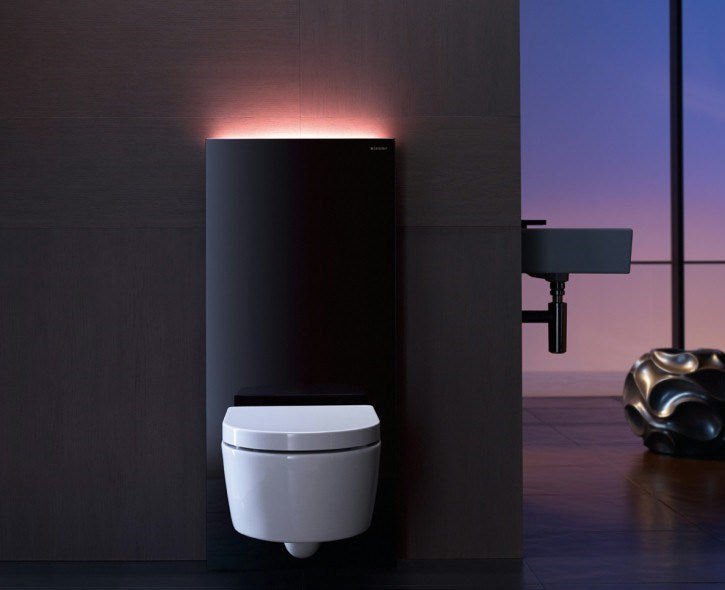
Geberit's Monolith sanitary modules take a different approach. The cistern is housed in a slim, finished unit with a glass front panel that stands against the wall, serving either a floor-standing or a wall-hung toilet. They come in 101 cm and 114 cm heights and in a choice of white, black, sand grey, lava and mint glass, giving the tidy look of a concealed cistern as a single designed piece.
Concealed Cistern Frames: Duofix, Kombifix and DuraSystem
A concealed cistern needs an installation element or frame that holds the cistern in place and carries the load of the toilet. The right one depends on how your wall is built:
- Geberit Duofix elements are statically self-supporting and designed for drywall construction, so they suit partition walls and new prewalls. Our Geberit Duofix frames also include elements for bidets, basins, showers and urinals.
- Geberit Kombifix elements are made for wet construction in front of a brick or concrete wall, designed to be embedded and bricked in before tiling, which suits the masonry construction found in many South African homes.
- Duravit DuraSystem frames come in versions for wet installation and for dry wall installation, plus a model with odour extraction and a hygiene flush.
Within Geberit, the cistern series matters too. Alpha is the most affordable concealed cistern in our range. Sigma comes in a standard 12 cm version and a slimmer 8 cm version for thinner wall build-ups. Omega is designed for lower installations, with construction heights of 112 cm, 98 cm and 82 cm and the option of flushing from the top at the two lower heights, which is useful where wall height is limited. Geberit also states that spare parts for its concealed cisterns remain available for 50 years, an important point for a component that will be tiled into the wall.
Flush Plates: The Part You See
With a concealed cistern, the flush plate is the only part on show, so it carries much of the design. Geberit names its plates after the matching cistern, so Sigma plates fit Sigma cisterns, Omega plates fit Omega cisterns and so on. Plates are available as:
- Mechanical plates, the simplest and most widely used option.
- Pneumatic plates, which use air pressure rather than a mechanical linkage to trigger the flush.
- Touchless electronic plates, such as the Sigma80 and the touchless Sigma10, which flush with a wave of the hand.
Finishes run from white and chrome to matt black, brushed metals, brass, gold and glass. Our flush plates collection holds nearly 300 options, almost all from Geberit, so you can match the plate to your taps, towel rails and accessories. There is a practical benefit too: on a Geberit concealed cistern, the service opening sits behind the flush plate, so a plumber can remove the plate to reach the valves for maintenance without opening the wall.
Dual Flush and Water Saving
In a water-scarce country, flush volume is worth checking. A dual flush cistern gives you a full flush for solids and a reduced flush for liquids. Geberit's Sigma cisterns are factory-set at 6 and 3 litres, and a plumber can adjust the full flush to a lower setting where the pan allows, saving water every day without any change in habit. Older single-flush cisterns use the full volume every time, so replacing one is one of the simplest water-saving upgrades in a home. Stop+Go cisterns achieve a similar saving by letting you stop the flush once the bowl is clear.
How Much Does a Toilet Cistern Cost in South Africa?
Toilet cistern prices vary widely with type and brand. As a guide, these are the price ranges on our site at the time of writing (November 2026):
- Exposed cisterns (Geberit AP range): around R700 to R3,400
- Close-coupled replacement cisterns: around R1,400 to R6,600
- Concealed cisterns on their own (Geberit Alpha, Sigma and Omega): around R1,900 to R4,600
- Geberit Kombifix elements with a concealed cistern: around R2,600 to R5,400
- Duofix and DuraSystem frames for wall-hung toilets: around R2,700 to R6,400, with specialist odour-extraction frames costing considerably more
- Flush plates: from around R450 for a simple plate, and roughly R10,800 to R19,600 for touchless electronic models
- Geberit Monolith sanitary modules: around R11,800 to R29,500
Remember that a concealed system is priced in parts. The frame and cistern, the flush plate and the pan are bought separately, and installation involves building work. Prices change, so check the live collections for current pricing.
How to Choose the Right Toilet Cistern
- Start with the pan. A close-coupled cistern must match its pan, and a wall-hung pan needs a concealed cistern and frame. If you are replacing a cistern, note the brand and range name first.
- Check how the wall is built. Drywall or a new partition points to Duofix or a DuraSystem dry wall frame, while a brick or concrete wall points to Kombifix or a wet installation frame.
- Check the height available. If wall height is limited, Omega's 82 cm and 98 cm installation heights may be the answer.
- Think about access. Choose a system where the valves can be reached through the flush plate opening and spare parts will be available for years to come.
- Choose the plate carefully. It must match the cistern series, and its finish should tie in with your taps and accessories.
- Confirm the water supply position. Many cisterns come in bottom, side or rear supply versions, so check where your pipe enters before ordering.
For help choosing the pan itself, read our guide to toilets in South Africa. If space is tight, our small bathroom ideas explain how a wall-hung toilet with a concealed cistern frees up floor space.
Find Your Toilet Cistern at Bella Bathrooms
Whether you are replacing a tired close-coupled cistern or planning a wall-hung toilet for a new bathroom, Bella Bathrooms stocks cisterns, installation frames and flush plates from Geberit and Duravit. Browse our concealed and exposed cisterns online, or visit our Kramerville showroom to see flush plates in person and talk through your wall construction with our team. Contact us for advice on the right toilet cistern for your project.
-
Posted in
buying guide, concealed cistern, flush plates, geberit, toilet cistern