Kitchen Taps: Types, Finishes and How to Choose the Right Mixer
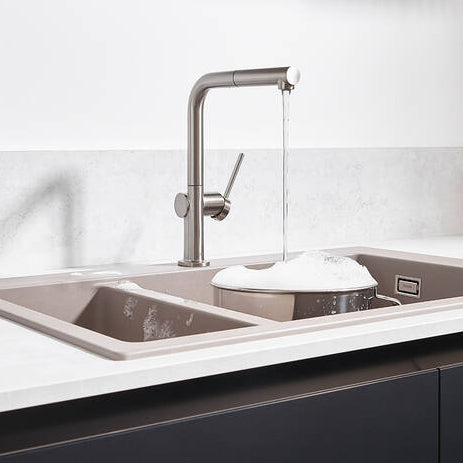
The kitchen tap is the fitting you touch more than any other in the house, and it is usually the one people think about last. The sink gets chosen for its size and material, the cabinetry gets planned around it, and then the tap is picked in the final five minutes. That is the wrong way round. Kitchen taps set the working height above the bowl, decide whether you can fill a stockpot without a fight, and carry the finish that ties the room together. Getting it right costs nothing extra; getting it wrong means a daily irritation for the next decade.
Deck-mounted and wall-type kitchen taps
Almost every kitchen tap falls into one of two mounting styles, and the decision is made by your plumbing rather than your taste.
Deck-mounted mixers
A deck-mounted mixer sits on the worktop or on the rear ledge of the sink itself, fed by flexible tails running down through a single tap hole. This is by far the most common arrangement, and the overwhelming majority of the kitchen taps range is built this way. Single-hole installation keeps the worktop tidy, makes replacement straightforward, and gives you the widest choice of spout shapes. If you are replacing an existing tap rather than planning a new kitchen, a deck-mounted mixer is almost certainly what you need.
Wall-type mixers
Wall-type mixers take their supply from the wall behind the sink and leave the worktop completely clear. They suit kitchens where the sink runs under a window with no ledge behind it, and they are easier to clean around because there is no base collecting water and limescale. The trade-off is that the plumbing has to be chased into the wall, so this is a planning-stage decision, not an afterthought.
Spout shape changes how the kitchen works
Spout shape is the single most practical decision in the whole exercise, and it gets far less attention than finish does.
Gooseneck and high-rise spouts arch well above the bowl and give you clearance to fill a kettle, a bucket or a tall vase without tilting anything. They suit deep single-bowl sinks and pair naturally with a butler sink, where the bowl sits high and forward. The one caution is window sills: measure first, because a high spout under a low sill will not swing.
J-spouts take a squarer, more angular path up and over, which reads as more contemporary and works well in kitchens built around straight lines and handle-less cabinetry.
Low-profile and swivel spouts keep the whole fitting compact. A swivel spout matters more than people expect in a double-bowl sink, because it is the only way to serve both bowls from one tap. Check the swivel range before buying: some are limited to a narrow arc and will not reach the far bowl of a wide double sink.
Pull-out and spray taps
A pull-out tap houses a spray head inside the spout on a retractable hose, so you can draw it out to rinse a large roasting tin, clean the sink itself, or fill a pot standing on the worktop rather than in the bowl. Dedicated spray mixers do something similar with a separate spray head alongside the main spout.
Both are genuinely useful in a busy kitchen, and both share one weak point: the hose and its retraction weight are moving parts, and they are the first thing to fail on a cheap tap. This is one of the places where paying for a known brand buys you something real, because replacement hoses and spray heads stay available. Handle them in a showroom before deciding, because the weight and pull action vary a lot between manufacturers.
Materials, cartridges and flow
Most quality kitchen taps are made from solid brass, either chrome-plated or given a coloured finish, with a smaller number in stainless steel. Brass machines cleanly, resists corrosion and takes plating well. Stainless steel taps, particularly those in 304-grade steel, suit people who want the raw metal look without a plated layer that can eventually wear.
Inside almost every modern mixer is a ceramic disc cartridge. Two polished ceramic discs slide against one another to control flow and temperature, and as Wikipedia's article on taps explains, the pairing works because two ceramic surfaces in contact have an unusually low coefficient of friction, especially with water acting as a lubricant. In practice that means a quarter-turn action, no washers to replace, and a tap that either works properly or needs a new cartridge rather than a service. When comparing taps, cartridge quality matters more than almost anything else you can see.
At the spout tip, the aerator mixes air into the stream. A faucet aerator reduces the volume of falling water, cutting both consumption and splashing in a shallow bowl. Aerators unscrew for cleaning, which in hard-water areas is worth doing once or twice a year.
One local note: South African domestic supply typically runs between one and five bar, and most kitchen mixers are designed for that range. If your home runs on a low-pressure gravity system, check the tap's minimum pressure requirement before ordering, because a high-arc spout on low pressure can trickle.
Finishes and how to coordinate them
Chrome remains the most stocked finish and the easiest to live with, because it hides water marks reasonably well and matches almost any sink. It is also the safest choice if you are not replacing everything at once.
Matt black has moved from a design statement to a mainstream option, and it works particularly well against stainless steel or white composite sinks. The black tapware range covers both kitchen and bathroom fittings, so a whole-house scheme is achievable. Gun metal sits between black and bronze and has become one of the more requested finishes for kitchens with warm timber cabinetry; the gun metal taps collection is a small, curated group rather than a broad range.
Beyond those, the range runs to brushed nickel, brushed brass, brushed stainless, champagne, and bronze tones including tiger bronze and lustre bronze, split roughly between polished, matt and brushed textures. Brushed finishes are the most forgiving in daily use because they disguise fingerprints and water spotting far better than polished surfaces do.
The practical rule is to match the tap to the fittings nearest it rather than to the room as a whole. A kitchen tap lives beside the sink waste and the cabinet handles, so those are what it needs to agree with.
Matching the tap to the sink
The sink comes first, and the tap has to answer it. Three things need checking before you buy.
Tap holes. An inset sink usually comes pre-drilled with one tap hole, which suits a single-lever mixer. Undermount and butler sinks generally have none, so the tap is mounted through the worktop and you can put it wherever it works best. If you are choosing both together, the kitchen sinks buying guide covers mounting types and bowl sizes in detail.
Bowl depth and spout height. Deep bowls need height above them. A shallow spout over a 200mm bowl will have you washing at an awkward angle.
Reach. The spout should deliver water into the middle of the bowl, not against the back wall or over the front edge. On a butler sink, which projects forward of the cabinet line, this catches people out regularly. Our butler sink guide goes into the fitting detail.
If your kitchen has a prep bowl or scullery sink, a compact prep bowl tap suits it better than a second full-size mixer. And if you want instant boiling water at the sink, that is a separate category of appliance, covered by the Zip Hydro Taps range.
Brands and budget
The kitchen tap range spans a wide price band. Entry-level mixers start a little over R600, the bulk of the range sits around the R3,000 mark, and designer pieces run into the tens of thousands. That spread reflects the difference between a serviceable chrome mixer and a hand-finished piece in an unusual metal.
The brands stocked most deeply are Blutide and Meir, followed by Hansgrohe, with Franke, Blanco, Gio Bella, Solo and Bijiou filling out the range. and AXOR at the premium end. Where long-term parts availability matters, and in a kitchen tap it does, the established brands are the safer bet.
If you are fitting out a whole kitchen rather than replacing one tap, browse the full kitchens range so the sink, tap and accessories are specified as a set. If the bathrooms are being done at the same time, the bathroom taps collection carries many of the same finishes.
Ready to choose?
Browse the full kitchen taps collection online, or come and try them properly. Spout height, swivel range and the weight of a pull-out hose are things you can only judge with your hands on the fitting, and everything is plumbed and running at our Kramerville showroom. Bring your sink dimensions and the team will help you narrow it down, over a decent cup of coffee.
-
Posted in
buying guide, kitchen mixer, kitchen sink taps, kitchen taps, kitchens