Kitchen Sinks: Types, Materials and How to Choose the Right One
The kitchen sink is the hardest working fixture in the house. It takes more daily use than anything else in the room, which is why choosing the right kitchen sink matters more than most people expect. Get the mounting style, bowl configuration and material right and the sink will still look and work well in fifteen years. Get it wrong and you will be reminded every time you wash up. This guide covers the main kitchen sink styles, the materials worth paying for, the sizes that actually suit South African cabinetry, and how to pair a sink with the right tap.
The three main kitchen sink mounting styles
Mounting style is the first decision, because it determines what your worktop fabricator needs to do and how much the installation costs. Our kitchen sinks range splits almost entirely into three groups.
Drop-in (inset) sinks
A drop-in sink sits in a cut-out in the worktop with a visible rim resting on the surface. It is the most forgiving option: the rim hides any imperfection in the cut, so it works with laminate, timber and stone alike, and it is the easiest style to retrofit into an existing kitchen. Most drop-in models include an integrated drainer to one side, and are listed with either a left-hand or right-hand drainer so you can match the layout to your window, hob and dishwasher position. Decide which side you want early, because it is not something you can change later. Browse the full drop-in kitchen sinks collection to compare current stock.
Undermount sinks
An undermount sink is fixed beneath the worktop, leaving an uninterrupted surface with no rim to catch crumbs. You simply sweep debris straight into the bowl. The trade-off is that undermount installation requires a solid worktop, granite, quartz, composite or solid surface, because the exposed edge of the cut-out becomes a visible finished edge. Laminate generally will not work. Undermount is the more expensive route once fabrication is factored in, but it is the cleaner look and it is where most new kitchen builds are heading. Interest in undermount sinks has been climbing steadily in local search over the past year. See the full under-counter kitchen sinks collection for current options.
Butler sinks
A butler sink is the deep, square, apron-fronted bowl associated with farmhouse and country kitchens, though it sits just as comfortably in a stripped-back modern scheme. These are heavy fireclay or composite bowls that need proper cabinet support beneath them. We cover this style in detail in our guide to butler sinks, and the full selection sits in the butler sinks collection, including compact baby butler bowls at around 400 x 350 x 200mm for prep areas and full-size 600 x 400mm units for the main run.
Kitchen sink materials
Stainless steel
Stainless steel remains the default for good reason. It is light, effectively unbreakable in domestic use, tolerant of hot pans, and easy to keep clean. The grade matters: quality kitchen sinks are pressed from 304 grade stainless steel, the chromium and nickel alloy commonly sold as 18/8 or 18/10, which resists the corrosion that thinner or lower-grade steel will not. Finish is worth considering too. A brushed or satin finish disguises scratches and water marks far better than a mirror polish, which is why almost every serious manufacturer uses it.
Granite composite
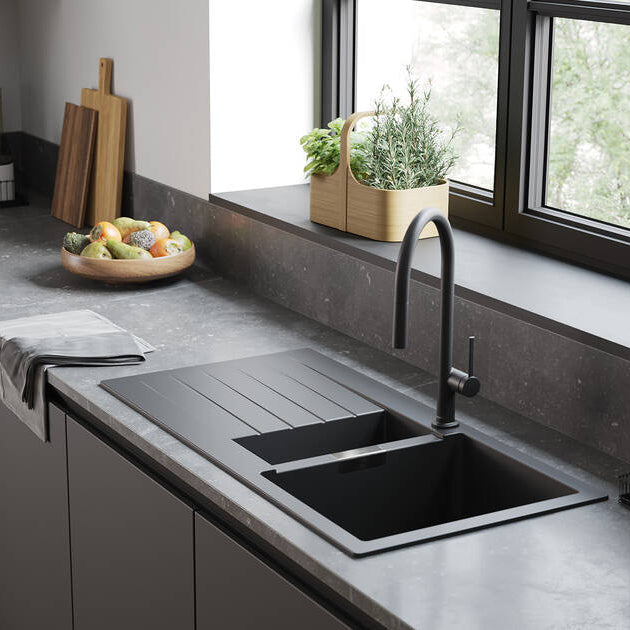
Granite composite bowls are moulded from crushed stone bound in acrylic resin. They are dense, quiet under running water, highly scratch resistant, and available in matt colours that stainless steel cannot offer. Black is the runaway favourite locally, and searches for black kitchen sinks have risen sharply over the last twelve months. Composite is the right answer if you want a sink that reads as part of the worktop rather than as a metal insert, and it pairs particularly well with matt black or brushed brass tapware.
Fireclay and ceramic
Fireclay is the traditional butler sink material: clay fired at very high temperature and glazed to a hard, glossy white surface. It is beautiful, genuinely durable, and forgiving of stains, but it is also unforgiving of dropped crockery. If you want the look with a little more give, composite butler bowls offer a similar profile in a tougher material.
Single bowl, double bowl or a bowl and a half
A single large bowl is the most practical choice for most households. It takes oven trays and grill pans that will not fit in a divided sink, and it suits the way most people now wash up, with a dishwasher handling the daily load.
A double bowl still earns its place if you wash and rinse by hand, or if you want to keep one side free while the other soaks. Demand for double kitchen sinks has grown noticeably this year. A bowl and a half, with a full bowl plus a smaller prep bowl, is the compromise: enough room for the large items, plus somewhere to rinse vegetables or park a colander.
Whichever you choose, think about the drainer. An integrated drainer is convenient but consumes worktop; a drainer-free undermount bowl paired with a separate drying rack frees up a surprising amount of usable surface.
Getting the size right
Sink size is dictated by your cabinet, not by preference. The base unit beneath the sink sets the maximum width, and you need clearance for the waste, trap and any water filter behind the bowl.
As a rough guide, single-bowl inset sinks with a drainer typically run from 800mm to 1050mm wide, with double-bowl and double-drainer models extending to 1200mm and beyond, up to around 1500mm for a full run. Undermount bowls are measured differently because there is no drainer to account for: common single bowls sit around 340 x 400mm, 400 x 400mm and 500 x 400mm, with depths between 180mm and 200mm. Depth is worth attention. A 180mm to 200mm bowl holds a stockpot comfortably; anything shallower will splash.
Measure your existing cut-out before you shop if you are replacing rather than rebuilding. Matching or slightly exceeding the old dimensions saves an expensive worktop modification.
Pairing your sink with the right tap
Sink and tap are bought together more often than not, and the pairing has real consequences. A deep single bowl needs a tall spout with enough clearance to fill a bucket or a tall vase. A pull-out spray head makes rinsing a large bowl far easier. Check the tap hole arrangement on your chosen sink, since some models are supplied undrilled for undermount installation where the tap is mounted through the worktop instead.
Our kitchen taps range covers everything from straightforward mixers to professional-style spring-neck models, and if you are weighing up finishes and valve types, the same principles set out in our taps buying guide apply. For households that want boiling and filtered water on tap, the Zip HydroTap range removes the kettle from the worktop entirely.
Wastes, traps and what comes in the box
Check what is actually included before you compare prices. Most quality kitchen sinks are supplied with a 90mm basket strainer waste fitting, and many include an overflow. Some are sold as the bowl alone, with the waste as an extra, which can close what looked like a meaningful price gap between two models.
Beneath the sink, the waste connects to a trap that holds a water seal and keeps drain odours out of the kitchen. If you are fitting a dishwasher or washing machine, make sure the trap you choose has the necessary spigot for the appliance hose. Wikipedia's overview of the domestic sink is a useful primer on how these components fit together.
Brands and budget
Across the range, kitchen sinks start at roughly R900 for a straightforward stainless steel inset model and climb past R6,000 for larger undermount, composite and butler options. The bulk of our range comes from Franke, whose Trendline, Projectline, Nouveau, Cascade and Smart series cover most cabinet sizes and both mounting styles, alongside Smeg undermount bowls, Teka, Blanco and locally made butler sinks.
If you are planning a full kitchen rather than replacing a single fixture, the wider kitchens collection brings the sinks, taps and kitchen accessories together in one place.
Ready to choose your kitchen sink?
The shortest route to the right sink is to start with your cabinet width and worktop material, then narrow by mounting style, then choose the material and finish. Browse the full kitchen sinks range online, or visit the Kramerville showroom to see the bowls at full size and get a feel for the depth and finish in person. Our team is happy to help you match a sink, tap and waste set that works together, and the coffee is excellent.
-
Posted in
buying guide, kitchen, kitchen sinks, sinks