Bathroom Tiles: Sizes, Finishes and How to Choose the Right Ones
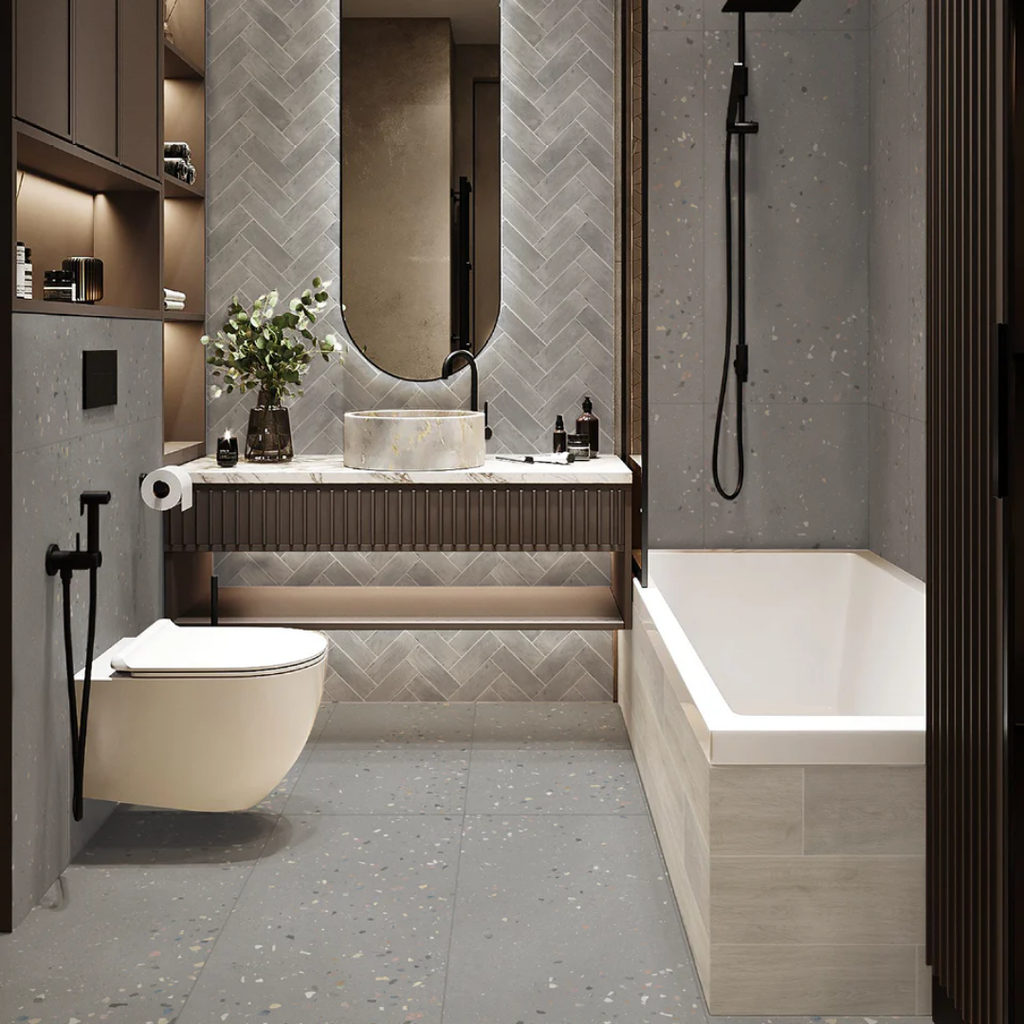
Choosing bathroom tiles is one of the few renovation decisions you cannot easily undo. Taps can be swapped, a vanity can be replaced in an afternoon, but tiles are bonded to the walls and floor for the life of the room. Getting the material, format and finish right at the start is what separates a bathroom that still looks considered in ten years from one that dates within two. This guide walks through what actually matters when you are standing in front of a wall of samples: porcelain versus ceramic, sizing, slip ratings, and how the pieces fit together.
Porcelain or ceramic: which bathroom tiles should you buy?
Almost every tile in a modern bathroom is one of two things, and the difference is denser than it first appears.
Porcelain
Porcelain is fired at a higher temperature from a finer clay body, which drives out nearly all internal porosity. The industry definition puts porcelain tile at under 0.5 percent water absorption, and that single number explains most of its advantages. It shrugs off moisture, resists abrasion far better than standard ceramic, and holds up on floors that take daily traffic and standing water. If you are tiling a shower floor, a wet room, or any bathroom floor at all, porcelain is the sensible default. Most of the large-format stock in our bathroom tiles range is glazed or polished porcelain stoneware for exactly this reason.
Ceramic
Ceramic is softer, lighter and easier to cut, which makes it a natural fit for walls. A glossy 75x300mm ceramic in a crackle glaze brings depth and a hand-made character that flat porcelain cannot quite match, and because it is not carrying foot traffic the lower density costs you nothing. Ceramic is also generally the more affordable option, so a common approach is porcelain underfoot and ceramic on the walls. Browse the wall tiles range if that is the split you are planning.
Getting the size and format right
Format changes the feel of a bathroom more than colour does. The tiles we stock run from 115x115mm squares up to 600x1200mm slabs, with plank formats like 200x1200mm in between, and each behaves differently in a small room.
Large format
600x1200mm tiles have become the default in new builds and full renovations. Fewer grout lines mean fewer visual interruptions, which makes a compact bathroom read as larger and considerably easier to clean. The trade-off is that large tiles are unforgiving of an uneven substrate: the wall or screed has to be genuinely flat, or the tiles will lip at the edges. Budget for proper preparation if you go this route.
Small format and mosaic
Smaller tiles do the opposite. They add texture, they follow curves and falls, and they are the practical choice for a shower floor where the screed slopes towards the waste. A 125x125mm square or a sheet from the mosaic tiles range will lie flat over a graded surface where a large slab simply cannot. Mosaics also work well as a feature strip or a niche lining, breaking up an otherwise uniform wall without committing the whole room to a busy pattern.
Finishes and slip resistance
Gloss, matt and polished finishes all look good on a sample board. On a wet bathroom floor they behave very differently.
Gloss reflects light and makes a small bathroom feel brighter, but it belongs on walls. For floors, look for matt or anti-slip finishes and check the R rating where it is published: an R10 tile has been tested for slip resistance on a ramp and is a reasonable minimum for a bathroom floor. Several of our porcelain floor lines are offered in both a standard matt and an anti-slip variant of the same colour, which lets you run one look across the room and step up the grip only where water collects.
Polished porcelain sits somewhere in between. It has the depth of a natural stone without the sealing regime, and it is stunning on a feature wall or a low-traffic guest bathroom floor. Think carefully before specifying it in a family bathroom or anywhere elderly users are showering.
Choosing a look that will last
Fashion moves through tile ranges faster than most people expect, so it helps to separate the styles that have staying power from the ones that will date.
Marble effect remains the safest premium choice. A Calacatta or Carrara-look porcelain gives you the veining without the porosity, staining and annual sealing that real marble demands. See the marble tiles range.
Subway has survived a century of trends and is not going anywhere. It is also cheap, easy to lay and adaptable: stack it vertically for a contemporary read, or run a traditional half-bond. Our subway tiles range covers both the classic white and the more interesting crackle and coloured glazes.
Wood-look and concrete-look porcelain gives you warmth or industrial calm in a room where real timber and raw concrete would be a maintenance problem. Plank formats such as 200x1200mm are convincing at floor level. Have a look at wood-look tiles and concrete tiles.
Terrazzo and décor tiles are where you take a risk deliberately. Used on a single wall, a vanity splashback or a floor inset, patterned tiles from the terrazzo and décor tiles ranges give a bathroom personality. Used across every surface, they overwhelm it.
Working out how much you need
Tiles are sold by the box, not the tile, and each box covers a stated area. Coverage varies widely with format: a box of small mosaics might cover half a square metre, while a box of 600x1200mm porcelain covers more than two. Prices in our range run from roughly R480 to R1,300 a box, so the useful comparison is always cost per square metre rather than cost per box.
Measure each wall and floor area, add the areas together, then add 15 percent for cuts and wastage. Add more if you are laying a diagonal or herringbone pattern, or if the room has awkward angles, since both generate a lot more offcuts. Order the full quantity in one go: tiles are produced in batches and the shade can shift slightly between production runs, so a top-up order weeks later may not match.
Grout, trims and the details that finish the job
The tile gets the attention, but the joint decides how the finished wall reads. Grout comes in sanded and unsanded forms, with sanded giving greater strength across wider joints and unsanded producing a smoother finish in narrow ones. Colour choice matters just as much: a grout matched to the tile disappears and lets a large-format wall read as a single surface, while a contrasting grout deliberately draws the grid.
Metal trims tidy external corners and the point where tiling stops, and a well-chosen trim in brushed brass or matt black can tie the tiling back to your tapware. It is a small detail that a good installer will raise and a rushed one will not.
If you are working with existing tiles rather than starting fresh, our guide on how to paint porcelain and ceramic tiles covers the surface preparation and primer choices that make the difference between a finish that lasts and one that peels.
Tying the tiles to the rest of the bathroom
Tiles are rarely chosen in isolation. The floor tile has to work with the shower tray or the fall of the screed, the wall tile has to sit sensibly behind the vanity, and the whole scheme has to survive being seen through a glass screen. Our guide to choosing shower doors is worth reading alongside this one, since the framing finish you pick there will either recede into the tiling or stand against it.
It is also worth thinking past the bathroom door. Running the same or a closely related tile through to an adjoining space makes a home feel considered rather than assembled room by room, and our kitchen tiles and outdoor tiles ranges share many of the same bodies and finishes.
See the tiles in person before you commit
Screens flatten texture and shift colour. A tile that looks warm grey online can read distinctly green on a wall, and the difference between a matt and a satin finish barely registers in a photograph. Browse the full bathroom tiles range online to shortlist, then come to our Kramerville showroom and see the shortlist under real light, at full size, next to the taps and basins you are considering. Our team can take your architectural plans, calculate quantities and coordinate delivery directly with your builder. Bring the plans, and stay for the coffee.
-
Posted in
bathroom tiles, porcelain tiles, tile guide, wall tiles